

https://cablematic.com/en/products/24-ghz-omnidirectional-antenna-and-10-dbi-AP002/
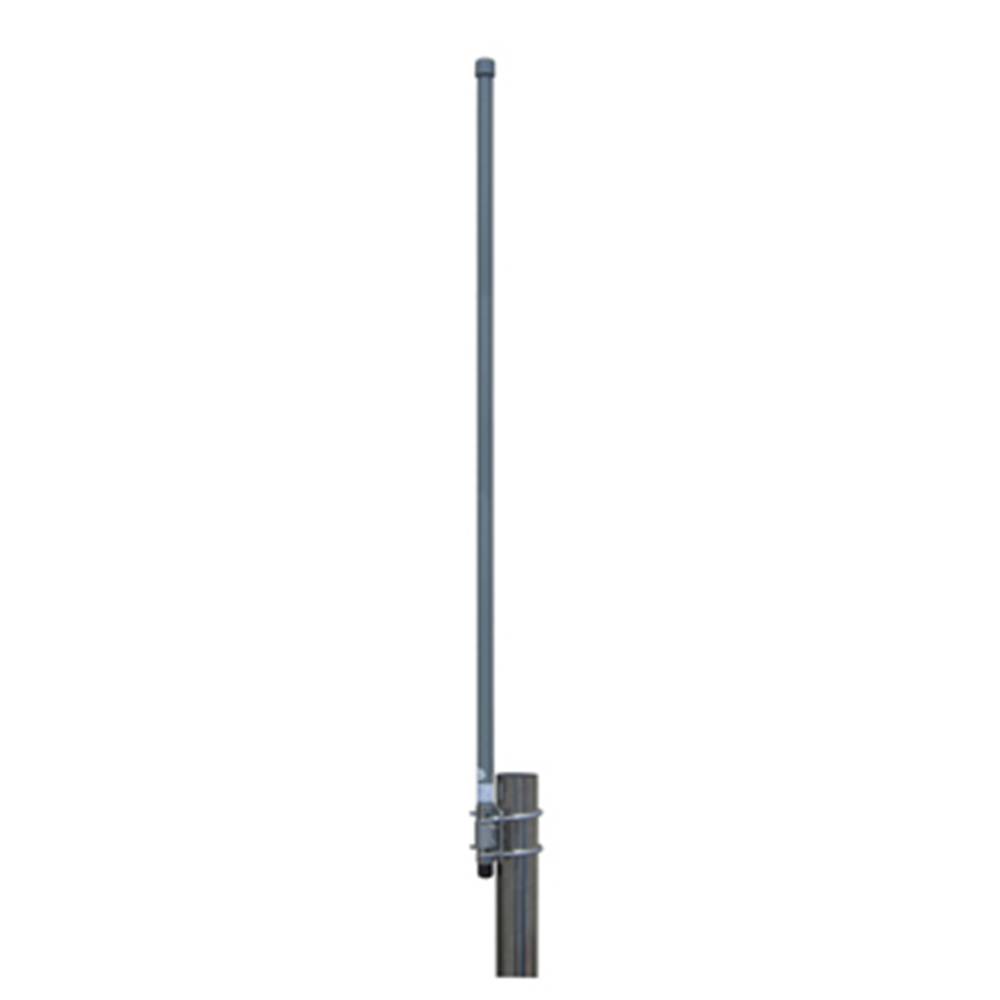

2.4 GHz omnidirectional antenna and 10 dBi

- Operating frequency: 2400 to 2483 MHz.
- Gain: 10dBi.
- VSWR: <= 1,5.
- Horizontal radiation angle: 360 °.
- Vertical radiation angle: 10.5 °.
 2 years
warranty
 14 days
returns
 100%
100%safe
- Operating frequency: 2400 to 2483 MHz.
- Gain: 10dBi.
- VSWR: <= 1,5.
- Horizontal radiation angle: 360 °.
- Vertical radiation angle: 10.5 °.
Purchased together regularly
More info
Omnidirectional antenna with 10 dBi gain and operating frequency of 2.4 GHz. Manufactured in light but resistant glass fiber to be installed outdoors. In the lower part it has a flat metal plate of 80 x 60 mm for direct fixing to the wall. It also adds two metal U-clamps for fixing to the mast.
Specifications
- Operating frequency: 2400 to 2483 MHz.
- Gain: 10dBi.
- VSWR: <= 1,5.
- Horizontal radiation angle: 360 °.
- Vertical radiation angle: 10.5 °.
- Polarization: Vertical.
- Impedance: 50 Ohm.
- Maximum power input: 100 W.
- Connector: N female at the bottom and integrated into the antenna.
- Length: 1000 mm.
- Diameter: 20 mm.
- Weight: 0.6 Kg.
- Mounting boom diameter: 30 to 50mm.
- Maximum wind speed: 241 Km/h.
- Gross Weight: 800 g
- Number of packages: 1
Technical terms
- Impedance
- Hz
- dBi
Impedance (Z) is the total opposition that a circuit offers to alternating current (AC) flow when a specific voltage is applied.
Unlike simple resistance, impedance is a complex quantity comprising resistance (the real part) and reactance (the imaginary part, representing inductive or capacitive effects). In the frequency domain, impedance is represented as a phasor, accounting for both magnitude and phase shift between voltage and current. In DC circuits, impedance reduces to pure resistance with zero phase angle.
| Parameter | Technical Spec |
|---|---|
| Symbol | Z |
| Unit | Ohm (Ω) |
Impedance management is critical in high-speed hardware design and signal integrity. In modern PCB manufacturing, controlled impedance ensures that high-frequency signals reach their destination without reflections, which is vital for PCIe or DDR5 performance.
Complex Domain Analysis
Mathematical modeling of impedance using the j-operator allows engineers to optimize filter performance and resonance characteristics in electronic systems.
Key Advantages
- Maximum power transfer through impedance matching.
- Minimized signal reflections in high-frequency transmission lines.
- Improved electromagnetic compatibility (EMC).
Note: Impedance is the cornerstone of modern AC circuit theory and high-frequency design.