

https://cablematic.com/en/products/omnidirectional-antenna-24-ghz-and-8-dbi-AP001/
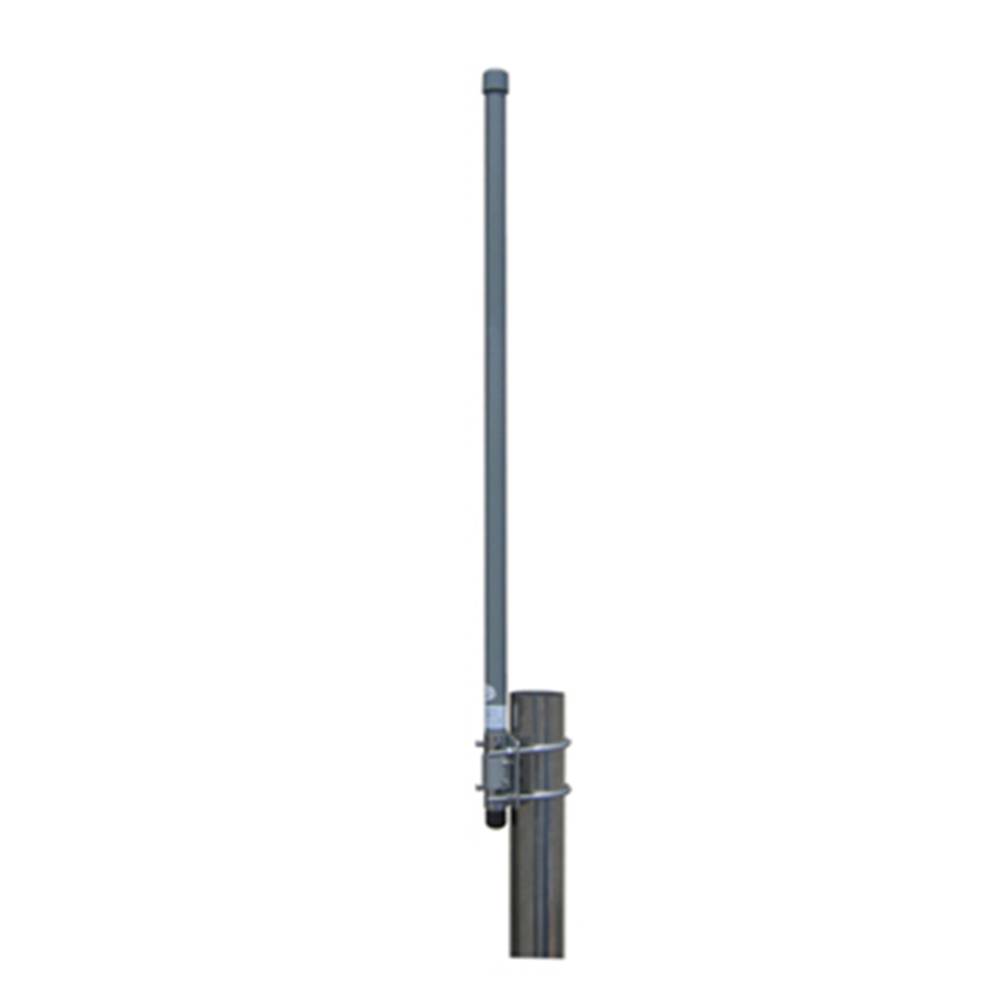

Omnidirectional Antenna 2.4 GHz and 8 dBi

- Operating frequency: 2400 to 2483 MHz.
- Gain: 8 dBi.
- VSWR: <= 1,5.
- Horizontal radiation angle: 360 °.
- Vertical radiation angle: 16 °.
 2 years
warranty
 14 days
returns
 100%
100%safe
- Operating frequency: 2400 to 2483 MHz.
- Gain: 8 dBi.
- VSWR: <= 1,5.
- Horizontal radiation angle: 360 °.
- Vertical radiation angle: 16 °.
More info
Omnidirectional antenna with 8 dBi gain and operating frequency of 2.4 GHz. Manufactured in light but resistant glass fiber to be installed outdoors. In the lower part it has a flat metal plate of 80 x 60 mm for direct fixing to the wall. It also adds two metal U-clamps for fixing to the mast.
Specifications
- Operating frequency: 2400 to 2483 MHz.
- Gain: 8 dBi.
- VSWR: <= 1,5.
- Horizontal radiation angle: 360 °.
- Vertical radiation angle: 16 °.
- Polarization: Vertical.
- Impedance: 50 Ohm.
- Maximum power input: 100 W.
- Connector: N female at the bottom and integrated into the antenna.
- Length: 600 mm.
- Diameter: 20 mm.
- Weight: 0.47 Kg.
- Diameter of the mounting pole: 30 to 50 mm./ li>
- Maximum wind speed: 241 Km/h.
- Gross Weight: 580 g
- Number of packages: 1
Technical terms
- Impedance
- Hz
- dBi
Impedance (Z) is the total opposition that a circuit offers to alternating current (AC) flow when a specific voltage is applied.
Unlike simple resistance, impedance is a complex quantity comprising resistance (the real part) and reactance (the imaginary part, representing inductive or capacitive effects). In the frequency domain, impedance is represented as a phasor, accounting for both magnitude and phase shift between voltage and current. In DC circuits, impedance reduces to pure resistance with zero phase angle.
| Parameter | Technical Spec |
|---|---|
| Symbol | Z |
| Unit | Ohm (Ω) |
Impedance management is critical in high-speed hardware design and signal integrity. In modern PCB manufacturing, controlled impedance ensures that high-frequency signals reach their destination without reflections, which is vital for PCIe or DDR5 performance.
Complex Domain Analysis
Mathematical modeling of impedance using the j-operator allows engineers to optimize filter performance and resonance characteristics in electronic systems.
Key Advantages
- Maximum power transfer through impedance matching.
- Minimized signal reflections in high-frequency transmission lines.
- Improved electromagnetic compatibility (EMC).
Note: Impedance is the cornerstone of modern AC circuit theory and high-frequency design.